
close
S
C
M
S
O
F
T
W
A
R
E
L
A
B

eCommerce ERP Integration — Shopify, WooCommerce, Magento, BigCommerce
Real-time order, stock, invoice sync · multi-store · multi-currency · DHL / FedEx / UPS / Aramex shipping APIs · 12+ years building integration brokers across India, the US, the UK, the UAE, Singapore and Australia.
eCommerce ERP integration is the layer that keeps your storefront and your back office honest with each other. The moment a customer clicks Buy, an order, a stock movement, an invoice, a customer record, a tax line, a shipping label and a refund window all have to update in lockstep — in the store, in the ERP, in the carrier system and on the customer’s screen. We build that broker. Real-time order capture, stock decrement, invoice posting, returns sync, payment reconciliation, and shipping label generation — one event, one source of truth.
Stack-agnostic. We connect any modern eCommerce platform — Shopify, WooCommerce, BigCommerce, WinxCommerce, Magento 2, Wix Commerce, PrestaShop and Laravel-based stores — to any modern ERP — iDempiere ERP consulting, SAP S/4HANA, SAP Business One, Tally and Zoho. Marketplaces such as Amazon and eBay slot into the same broker. Carriers go through DHL, FedEx, UPS and Aramex APIs. Your ERP is the system of record; the store is a sales channel; the broker is the contract.
Real-time, bidirectional, idempotent, observable. Webhooks drive the flow. Operations are idempotent — the same order can fire twice without double-posting. A dead-letter queue catches failures, a retry policy fixes most of them, and a run dashboard makes the rest visible. Every sync writes an audit log, every transaction has a correlation id, and every customer-facing flow has an alerting hook on it. That is why our integrations keep running long after the developer leaves the project.
Built for global rollouts. Multi-store, multi-currency, multi-warehouse, multi-tax. One ERP can sit behind a Shopify store in India, a WooCommerce store in the UAE, a BigCommerce store in the US and a marketplace in Singapore — each in its own currency and tax regime, all rolled up into the ERP base currency on close. For carrier and last-mile design see our DHL / FedEx / UPS carrier integration service.
From Our Portfolio — Live eCommerce ERP Brokers
Shopify, WooCommerce, BigCommerce and WinxCommerce stores synced with iDempiere, SAP and Tally in real time — with DHL, FedEx, UPS and Aramex carrier labels generated on the same flow. The architecture below ships on every engagement we run.
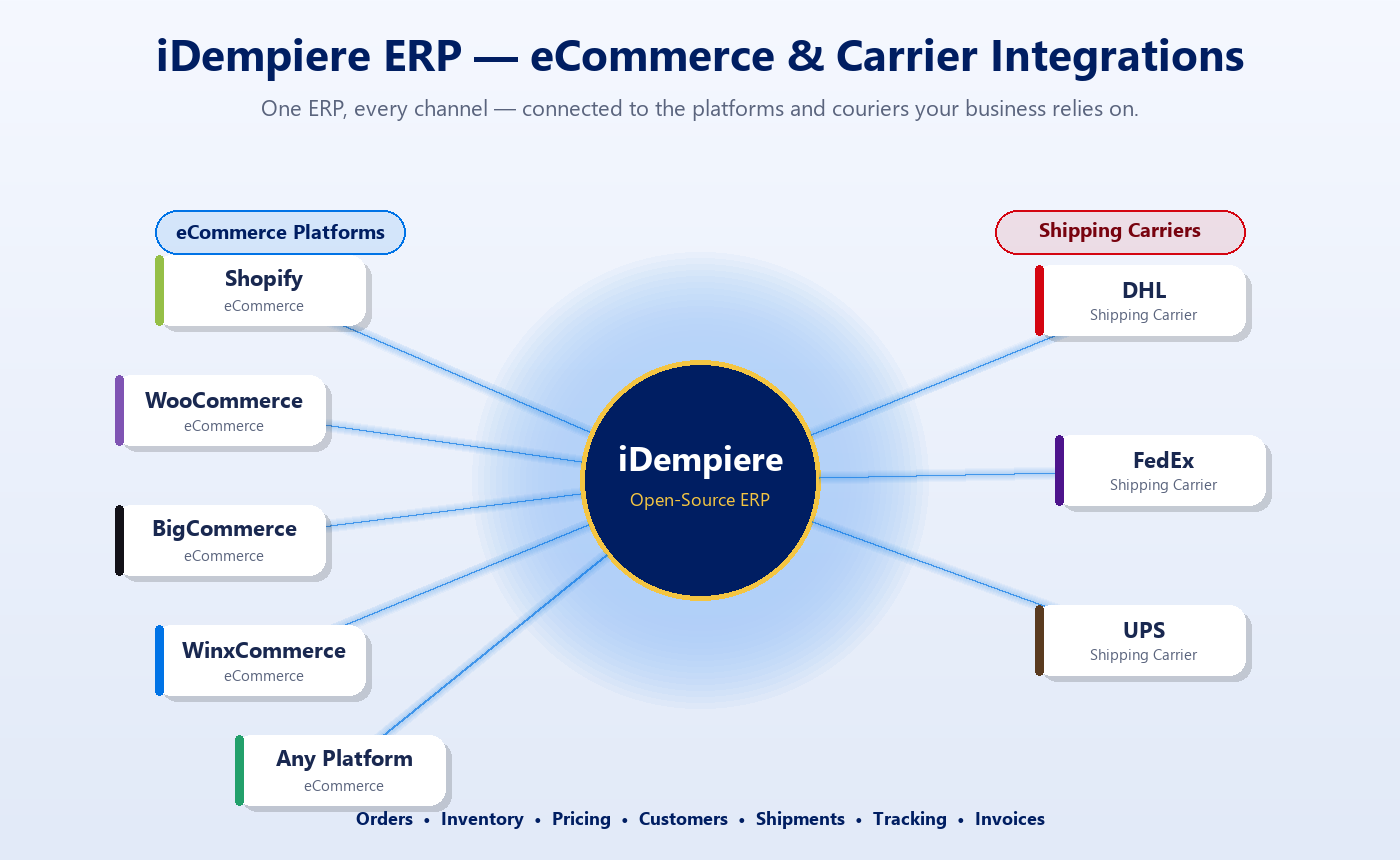
The anatomy of a real ecommerce erp integration
Six things every serious integration needs
Most failed integrations were missing one of these six layers from day one. Every broker we ship has all six — they are not extras, they are the floor that keeps your store, your warehouse and your finance team honest.
Order capture
Shopify, WooCommerce or Magento webhook fires the instant an order is placed — the broker creates a sales order in the ERP within milliseconds, with all line items, tax lines and shipping fields populated.
Stock update
Every ERP stock movement — sale, return, transfer, adjustment, write-off — pushes a live inventory level to every connected channel, so you never sell a SKU you cannot ship.
Pricing push
ERP price lists, customer-tier discounts and promotional overrides land on the storefront within seconds — one price change in the ERP, every store updated at once.
Returns sync
RMA in the store creates a return order in the ERP, reverses the GL postings, restocks the warehouse line and triggers the refund through the payment gateway — all in one flow.
Capture
Webhook lands, schema validation runs, customer is matched or created, duplicates are de-duped on email or phone, and the order is committed in the ERP as a sales order in seconds.
Reserve stock
ERP inventory is reserved against the order, the warehouse sees an allocated line, and the available-to-promise is decremented across every connected channel.
Generate invoice
Tax-compliant invoice is generated in the ERP with GST or VAT lines, dispatched as a PDF to the customer, and stored against the order in versioned document storage.
Pick-pack-ship
Picklist routes to the right warehouse, packlist confirms quantities, AWB is generated against DHL, FedEx, UPS or Aramex, and the tracking number lands on the storefront.
Settle
Payment confirmation reconciles against the invoice, GL journal posts to the right cost centre, and the customer sees the order marked Delivered the moment the carrier confirms it.
Master catalog
SKUs, descriptions, images, attributes and category trees managed once in the ERP — pushed to Shopify, WooCommerce, BigCommerce and marketplaces with per-store scoping.
Multi-currency price lists
INR, USD, GBP, AED, SGD and AUD price lists managed in the ERP with rate-driven conversion and store-specific overrides — same product, different price per geography.
Variants
Size, colour, material and configurable bundles modelled as ERP product variants and exposed as Shopify variants or WooCommerce variations — one parent, many child SKUs.
Promotions
Time-bound discounts, coupon codes, BOGO offers and bundle pricing authored in the ERP — the storefront only renders what the ERP has authorised for this customer.
B2B price tiers
Customer-group price lists, contract pricing, MOQ rules and tax-exempt flags all drive the storefront price for a logged-in B2B buyer — the same engine that drives invoicing.
DHL, FedEx, UPS, Aramex APIs
Pre-built connectors against the major global carriers — live rate quotes, service-level pickers, address validation and pickup scheduling all driven from the ERP sales order.
AWB generation
Airway bill or waybill is generated the moment the warehouse confirms pick-up — multi-piece shipments, dimensional weight, COD flags and insurance values populated correctly.
Live tracking
Carrier tracking events — pickup, hub-in, out-for-delivery, delivered, exception — ingested back into the ERP and surfaced on the storefront order detail page in real time.
Manifest
Daily carrier manifests generated and posted automatically — the warehouse handover sheet matches the carrier scan-in, and reconciliation against the carrier invoice is one click.
Payment gateways
Razorpay, Stripe, PayPal, Cashfree, PayU and PayTabs all integrated into the order flow with capture, refund and partial-refund handling on the same idempotent broker pattern.
GST / VAT compliance
India GST, UAE VAT, UK VAT, Saudi VAT, Singapore GST and Australian GST handled in the invoice line itself — not bolted on as a CSV export at month-end.
GL journal export
Every settled order posts a journal entry to the right revenue, tax, shipping, discount and COGS accounts — mapped per store, per warehouse, per currency, per legal entity.
Reconciliation
Daily payment settlement file is matched against the ERP invoice list, mismatches flagged on the run dashboard, and unattributed transactions surfaced as exceptions before the close.
Webhook retries
Failed webhook deliveries are retried with exponential backoff against a configurable schedule — transient ERP outages, API throttling and 502 spikes do not lose data.
Idempotent operations
Every write carries an idempotency key. A double-fired webhook, a replayed message or an at-least-once delivery produces exactly one ERP record — never two.
Dead-letter queue
Messages that exhaust the retry budget land in a DLQ with the full payload and the last error — replayable from the dashboard the moment the underlying issue is fixed.
Run dashboard
Real-time view of orders processed, orders pending, orders failed, average broker latency, webhook hit rate and per-store error breakdown — on one screen, refreshed live.
Audit log
Every payload received, every payload sent, every retry, every DLQ event is recorded with a correlation id — full traceability from the click on the storefront to the GL entry.
Platform Capabilities
Twelve engineering choices that turn a Zapier-style toy into an enterprise-grade ecommerce erp integration. Every broker we ship has all twelve — from week one, not retrofitted in year two under audit pressure.
Real-Time Webhooks
Orders, stock, refunds and customer changes fire as webhooks in milliseconds — not as a nightly job that misses the Friday cut-off.
Bidirectional Sync
Store-to-ERP and ERP-to-store traffic on the same broker, with conflict-resolution rules so the right side wins per field, per entity.
Multi-Store
One ERP can sit behind dozens of stores across geographies — per-store catalog scoping, per-store pricing, per-store warehouse routing.
Multi-Currency
Each store sells in its local currency, the broker normalises into the ERP base currency on close, with FX gain or loss booked correctly.
Multi-Warehouse
Inventory is read from the right warehouse for the shipping postcode, and orders route to the closest fulfillment node automatically.
GST / VAT Compliant
India GST, UAE VAT, UK VAT, Saudi VAT, Singapore GST and Australian GST handled at the invoice-line level — not as a month-end CSV export.
Idempotent Operations
Every broker call carries an idempotency key — a replay, a double-fired webhook or a network retry produces exactly one ERP record.
Retry & DLQ
Exponential-backoff retries on every transient failure; permanent failures land in a dead-letter queue with full payload, replayable from the dashboard.
Run Dashboard
Live view of orders processed, latency, retries, DLQ depth and per-store error breakdown — one screen, refreshed without a page reload.
REST + GraphQL
REST endpoints for traditional integrations, GraphQL for Shopify Admin API and BigCommerce Storefront API — the broker speaks both fluently.
OAuth + API Keys
OAuth 2.0 against Shopify and BigCommerce, signed API keys against WooCommerce and Magento, mTLS where the carrier demands it — secrets in Vault, never in the repo.
Sandbox-First Rollout
Every broker is staged in a sandbox first — dual-run against the production store, side-by-side reconciliation, only then cut over to live traffic.
Stack-agnostic — pick any eCommerce, any ERP, any carrier
We are not selling you a closed connector that locks you to one store and one ERP. We are building you a broker — a stateless, idempotent middleware that speaks the API of every storefront, every ERP and every major carrier. On the storefront side we have shipped against Shopify, WooCommerce and BigCommerce integration, plus Magento 2, WinxCommerce, Wix Commerce, PrestaShop, OpenCart, Amazon Seller Central and eBay. The same broker fronts all of them.
On the ERP side the broker normalises into a canonical order, product, customer and invoice schema, then writes against your real system of record — iDempiere ERP consulting, SAP S/4HANA, SAP Business One, Tally ERP, Zoho Books, Microsoft Dynamics 365 Business Central or Oracle NetSuite. Field mapping is YAML-driven, so a new ERP is a configuration change, not a rewrite. For warehouse and logistics-grade ERP rollouts see our ERP with WMS page.
On the carrier side we have pre-built mappings for DHL Express, FedEx, UPS and Aramex with live rates, AWB generation, tracking ingestion and manifest output. If a carrier exposes a documented API, we can wire it in within a sprint. The result is an integration that survives store migrations, ERP upgrades and carrier swaps — because the contract is the broker, not the endpoints.

What We Actually Do — The Six-Stage Engagement
Six discrete stages, each with a deliverable you can show to a sponsor on a Monday morning. No black-box, no “trust us, it’s coming.”
Discovery & Field Mapping
We sit with your store admin, your ERP admin and your finance team for one week — mapping every field on every flow between your store and your ERP. Output: a signed-off mapping document and a sandbox plan.
Integration Build (API + Webhook)
The broker is built in Java 17 / Spring Boot 3 with idempotent operations, retry and DLQ baked in. Webhook subscriptions are registered, REST and GraphQL clients are generated, and the run dashboard ships in the same release.
Catalog & Pricing Setup
Master catalog in the ERP is normalised — SKUs, variants, attributes, images. Multi-currency price lists are loaded, B2B tiers are configured, and the first push to your live store is validated SKU by SKU.
Carrier API Setup
DHL, FedEx, UPS or Aramex accounts are wired in — live rate quotes on the cart, AWB generation on the warehouse pick, tracking events ingested back into the ERP, manifest output for the carrier handover.
Go-Live & Sandbox-First Rollout
Two weeks of dual-run — broker watches live traffic in shadow mode, every event reconciled side-by-side with your existing flow. Cut-over to live writing only when the reconciliation is clean for five days straight.
AMS / Continuous Tuning
Application Managed Services after go-live — 24x7 alerting on DLQ depth and broker latency, monthly review of failed events, schema changes when the store or the ERP releases a new API version.
Measurable Outcomes — What Changes On Day One
Not abstract benefits, not generic “efficiency” promises — nine specific operational changes you can verify in your own dashboard within the first month of the broker going live.
No more re-keying orders
Your ops team stops copying orders from the Shopify admin into the ERP — the broker does it in milliseconds, with the audit trail to prove it.
Stock accuracy > 99%
Real-time stock decrement across every connected channel means you stop overselling SKUs that another store sold ten seconds ago.
1-day GL close
Every settled order posts a GL journal automatically — finance closes the day’s books on Tuesday morning instead of chasing CSV files on Thursday.
Real-time courier AWB
AWB is generated the moment the warehouse confirms a pick — the customer sees the tracking number on the order detail page within a minute.
Returns processed faster
RMA flow is one click for the customer, one webhook for the broker, and one reverse GL post for finance — refund hits the customer in 24 hours, not seven days.
Audit trail on every sync
Every payload received, every payload sent, every retry, every DLQ event is recorded with a correlation id — full traceability, statutory-ready.
Multi-store rollups in one ERP
Six stores in six geographies roll up into one ERP P&L, one inventory ledger, one customer master — the CFO sees the group, the country manager sees the country.
Pre-built mappings for popular ERPs
iDempiere, SAP Business One, Tally, Zoho and Dynamics 365 have ready field mappings — weeks shaved off the discovery and the build stages of your engagement.
24×7 alerting & DLQ
Pager goes off when DLQ depth exceeds a threshold or broker latency degrades — you do not find out from an angry customer on Monday morning.
Four-stage engagement — discovery to live in weeks, not quarters
HOW WE TAKE YOUR ECOMMERCE ERP INTEGRATION FROM ZERO TO PRODUCTION
Discover
One-week workshop with your store, ERP and finance leads — we walk the order lifecycle end-to-end and surface every field, every edge case.
Map
Signed-off mapping document — every field on every entity, every webhook payload, every retry rule, every escalation path — before a line of code.
Build
Broker built in Java 17 / Spring Boot 3, sandbox-deployed, run dashboard wired up — first end-to-end order moves on your data in week three or four.
Roll out & operate
Two-week dual-run, cut-over when reconciliation is clean for five straight days — then AMS kicks in with 24×7 alerting and continuous tuning.
Industries Where Our eCommerce ERP Brokers Run
Eight verticals where we have already shipped production brokers between modern eCommerce platforms and modern ERPs. Each one has a use case the rest of the industry can copy.
D2C Retail
Shopify storefront, iDempiere back office, Razorpay payments, DHL last-mile — one broker covers the full direct-to-consumer flow.
B2B Wholesale
Customer-group price lists, MOQ enforcement, contract pricing and credit-line invoicing managed in the ERP and surfaced on a B2B portal.
Marketplaces
Amazon and eBay order ingestion into the ERP with seller-fee reconciliation, settlement-report parsing and SKU-to-ASIN mapping.
Pharma / Health
Batch and expiry tracking on every SKU, prescription validation gating the order, and statutory drug-licence reporting on the ERP side.
Fashion
Size-and-colour variants, season-tagged catalogues, end-of-season markdown automation and high-volume returns synced to the warehouse.
Electronics
Serial-number tracking against every unit, warranty registration on order completion, and RMA processing tied to the original AWB.
Grocery
Hyperlocal warehouse routing, fresh-food expiry constraints, dynamic delivery slots and route-optimisation handoffs to the last-mile carrier.
Books & Media
ISBN-driven catalogues, publisher drop-ship integration, royalty calculations on the ERP and digital-asset fulfilment alongside physical SKUs.
Run a real Shopify → ERP sync in 10 days. Free POC. NDA-first.
Before you commit to a quarter-long engagement, we build you a live broker that moves a real order from your live store into a sandbox of your ERP — with your SKUs, your customers, your tax setup, your carriers — in ten working days. You see the audit trail, you see the latency, you see the DLQ. Then you decide whether to scope the full build.
- NDA-first · transparent rates
- 10-day working broker
- Full source code & IP ownership
+91 90524 31162 | sales@scmsoftwarelab.com
What you get in the POC
One real flow — usually order capture from Shopify into iDempiere, SAP Business One or Tally — running end-to-end on your data. Includes a run dashboard, retry policy and a DLQ, plus a clear cost-and-timeline estimate for the full build with no obligation to continue.
For broader scoping, see our custom web application development capability and our DHL / FedEx / UPS carrier integration service. No risk. Real broker. Then you decide.
Your users ask. Your app answers.
Forms and filters are dead UX. We embed an AI conversation layer into the apps we ship — so end users get answers, charts and actions in seconds, without learning your menu tree.
Show me top 10 customers by revenue this quarter
U
Here are your top 10 — total Q3 revenue ₹4.82 Cr.
Acme Industries₹78.4L
Flipkart₹62.1L
Tata Steel₹54.8L
Draft a renewal offer letter for Priya Sharma
U
Done — drafted using her grade revision and CTC, sent to HR review queue. Open draft →
Ask anything…
Built with Anthropic Claude
An AI layer inside your product — not bolted on.
Every page we build now ships with an optional AI assistant that reads your real data — sales, payroll, inventory, tickets — and answers in natural language. No new tab, no separate chatbot tool. Just a conversation, where the work happens.
Behind the scenes we also build with Claude — pairing it on architecture, code generation, test writing and migrations. The same AI that writes our code now lives inside your app to serve your customers.
Natural-language queries
Voice input
Multi-language
Document understanding
Action shortcuts
Personalised summaries
1
Ask
Your user types — or speaks — a plain English question or instruction inside your app.
2
Understand
Claude maps intent, calls your APIs with the right filters, and stays inside your role-based access scope.
3
Answer
The answer lands as a chart, table, summary or one-click action — right inside your app, not in a side panel.
Add an AI layer to your app
NDA-first · 30-minute strategy call · we ship a working prototype in two weeks
We don’t bolt on integrations — we engineer brokers.
Idempotent, observable, retry-safe by default. Every payload signed, every retry logged, every dead-letter replayable. That is why our integrations keep running after the developer leaves — because the broker was built to be operated by your team, not just shipped by ours.
Why Choose SCM for eCommerce ERP Integrations
Not pricing alone, not consulting hours — the engineering bar inside the broker. Nine choices any CTO, ops head or finance lead can verify on day one of the engagement.
Stack-Agnostic
Any modern eCommerce platform on one side, any modern ERP on the other, any major carrier in the middle — the same broker pattern fits all of them.
Real-Time Webhooks, Not Nightly Batches
Orders, stock, payments and refunds fire as webhooks the moment they happen — your customer sees a tracking number within minutes, not by Friday morning.
Idempotent Operations With Retry + DLQ
Every broker write is idempotent. Transient failures retry automatically. Permanent failures land in a DLQ with the full payload and the last error.
Pre-Built Mappings for Shopify, WooCommerce, Magento
The discovery and the mapping stages of your engagement start with a head-start — not a blank YAML file — saving weeks of timeline.
Multi-Store, Multi-Currency, Multi-Warehouse
One ERP can sit behind dozens of stores in different currencies, with stock allocated from the right warehouse for every shipping postcode.
India Offshore + Global On-Call
Senior India-based engineering at offshore rates, with on-call coverage that wakes up on UK, US, UAE and Singapore time-zones — not a 12-hour silence.
Sandbox-First Rollout — Never Go Live Blind
Two-week dual-run, side-by-side reconciliation, cut-over only when the broker is clean for five straight days — not on a Friday-night hope.
Full Source Code & IP Ownership
You own the broker code on day one under a clean transfer-of-rights clause. No hidden runtimes, no per-event licence, no surprise — walk away anytime.
NDA-First, Transparent Rates
Engagement starts under NDA, with daily or weekly rates published up front, weekly demos and a senior engineer accountable from day one.
Frequently Asked Questions
Eight questions buyers ask most when comparing eCommerce ERP integration partners — the kind of answers your CTO and your CFO will both want to see in writing.
Which eCommerce platforms do you integrate with?►
We ship production-grade integrations with Shopify, WooCommerce, BigCommerce, Magento 2, WinxCommerce, Wix Commerce, Laravel-based stores, PrestaShop and OpenCart — plus Amazon Seller Central and eBay marketplaces. The same integration broker fronts any of them, so adding a second store later is a configuration change, not a rewrite.
Which ERPs do you support?►
We have pre-built mappings for iDempiere, SAP S/4HANA, SAP Business One, Tally ERP and Zoho. We have also integrated with Oracle NetSuite, Microsoft Dynamics 365 Business Central and several home-grown Java and .NET ERPs. If your ERP exposes a REST, SOAP or message-queue interface, we can wire it in.
Is the sync real-time or batched?►
Real-time, webhook-driven, with batch as a fall-back. Orders, payments and stock adjustments fire as webhooks the moment they happen in the store, and the broker pushes them to the ERP in milliseconds. Nightly batches are reserved for catalog backfills and reconciliations — not for the customer-facing flow.
How do you handle out-of-stock during checkout?►
We reserve ERP stock the instant an order is placed and release the reservation on cancellation, expiry or refund. Where the store supports it we also push live ATP — available-to-promise — back to the storefront, so a customer cannot complete a checkout for a SKU that another customer reserved one second earlier.
What about returns and refunds?►
Returns and refunds are first-class. The store posts an RMA, the broker creates a return order in the ERP, reverses the GL postings, restocks the inventory at the original warehouse and triggers the refund through the payment gateway — with the audit trail visible on every step in the run dashboard.
How is multi-currency and GST/VAT handled?►
Each store sells in its native currency and tax regime. The broker normalises everything into the ERP base currency using configurable rates, books GST or VAT correctly per the jurisdiction, and posts to the right GL accounts. India GST, UAE VAT, UK VAT, Saudi VAT, Singapore GST and Australian GST are all covered out of the box.
Do you support multi-store and multi-warehouse rollouts?►
Yes. One ERP can sit behind dozens of stores across geographies, with per-store catalog scoping, per-warehouse stock allocation, and per-channel pricing. Inventory is read from the right warehouse for the customer’s shipping postcode, and orders route to the closest fulfillment node automatically. For deep warehouse rollouts see our ERP with WMS page.
How long does a Shopify-to-ERP integration typically take?►
A focused Shopify to iDempiere or Shopify to SAP Business One integration with order, stock, invoice and customer sync lands in 6 to 10 weeks end-to-end — including discovery, sandbox build, dual-run with the live store, and a sandbox-first go-live with monitoring on day one. We run a free 10-day proof-of-concept first so you can see the broker move a real order before you commit.
Ready to connect your store and ERP?
NDA-first · transparent rates · free 10-day proof of concept — let’s scope the right integration broker for your stack in a 30-minute call.
Schedule a 30-min scoping call